
While I was in the studio working yesterday, I also had time to resolve an issue I was having with the top left corner of my silver painting. Now it is almost complete.

 I've found yet another use for packing material. This paper was crumpled up around a mirror I bought last year.


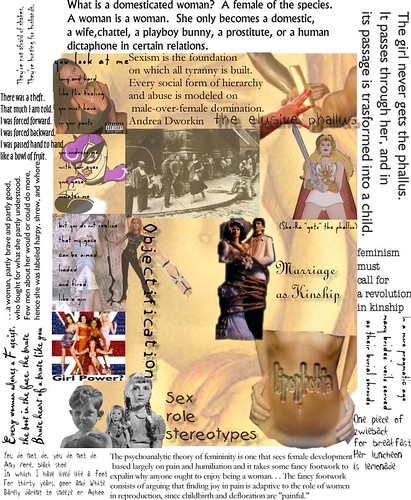
My montage brings out the recurring themes of the feminist poetry and prose that we read near the end of the quarter. At the very top is a quote from Andrea Dworkin which states that “sexism is the foundation on which all tyranny is built. Every social from of hierarchy and abuse is modeled on male-over-female domination.” I found this quotation particularly relevant to the piece because an outcry against sexism is what these texts are built upon. Rubin’s essay addressed the idea of penis envy in a fresh and memorable way. On page 195, she says,
The girl never gets the phallus. It passes through her, and in its passage is transformed into a child. When she “recognizes her castration,” she acceded to the place of a woman in a phallic exchange network. She can “get” the phallus--in intercourse, or as a child--but only as a gift from a man. She never gets to give it away.
With this in mind, I decided that it was a very important part of the essay, one definitely worth of visual interpretation. But how? As I read over the essay for the second time, I realized that the phallus as she describes it is a “symbolic token,” (Rubin, 194) “the set of meanings conferred upon the penis.” (190) I learned from studying the ideas of Freud and others of the psychoanalytic school that phallic symbols are ubiquitous in our society, whether in the form of skyscrapers, telephone poles, or even cigars. The image I finally selected for this is that of a golden baton being passed on from one male relay racer to another, the baton being the phallus. And superimposed upon them is the outstretched hand of an infant, reaching for the phallus yet not obtaining it. This symbolizes the Freudian Oedipal struggle of infancy. Beneath this I placed a picture of a female superhero who, although objectified in her skimpy costume, has obtained the phallus in the form of a sword.
Objectification is a recurring theme in the feminist poetry and prose, particularly in “The Venus Hottentot” and also in “The True Bride,” where the speaker describes his “ideal pornography”--an army of hobbling invalid women “hunting for husbands.” (601) Objectification, the portrayal of women as sex objects, strips women of their humanity. Sadly, I found far too many visual examples of this. In the objectification portion of my collage, I use images that come from four different media: music, the internet, fashion, and the movie industry. Also included in this section is a poem that I wrote about being perceived as an object.
Marriage is almost always portrayed in these texts in a negative light, so I selected the image of bride and groom dolls bound together with twine. Also included, though not as greatly emphasized, are sex role expectations and stereotypes. The stiff, unsmiling girl who seems displeased with her look-alike doll is an image of passivity while the pugnacious little boy in boxing gloves is an image of aggression.