Saturday, April 27, 2019

The Spring 2019 One of a Kind Show

It was hard to capture in this photo, but this year the wall was a shade of coral, the Pantone color of the year.


Though it started out pretty warm on Friday, this weekend has become the kind of weekend that makes you want to stay indoors and out of the cold, soggy weather. The Spring One of a Kind Show is a great reason to stay inside the Merchandise Mart, with so many talented artists, artisans, and chefs. It was nice to see some of my favorite vendors return, like Christopher Royal, Case Island Glass,  Mark Gleberzon, Gourmet Goodies, Mohop, Tara Locklear Jewelry, Zooguu, Necknots, Jenny Johannsen, Chula House, and Larissa Loden. Here are the new artisans whose work caught my eye this year:


https://akesestylelines.com
Akese Stylelines

Nicola Rix


Susan Haas Glass
Susan Haas Glass

Indigo Ink Designs
Indigo Ink Designs
Triple A Gourmet Treats

Lincoln + Hobbs
Lincoln + Hobbs
Stone Fashion by Bill Stone Studio


Plankroad
Plankroad

Malka Chic


KJ Made
KJ Made

Made by Nico
Made by Nico


Han Bruzan Studio
Han Bruzan Studio


http://gloriakirk-hanna.com/
Gloria Kirk-Hanna

Rush Creek Glass
Rush Creek Glass

Lost Art Woodworks
Lost Art Woodworks
Andrew Iannazzi
Andrew Iannazzi

Courtney Vészi
Courtney Vészi

The Hedge Studios
The Hedge Studios
Kimberly Polka
Kimberly Polka

Elizabeth Edwards
Elizabeth Edwards


Lambkin Studios
Lambkin Studios

Patricia Coleman-Cobb

Laser Eye Shop
Laser Eye Shop

Second Touch Art
Second Touch Art

Dosa Natural Skin Care Products
Dosa Natural Skin Care Productshttps://dosanaturals.com


Brainchild Conspiracy

Sarah Mimo Manufactory


The show continues tomorrow and ends at 5 p.m. See it if you can.

Tuesday, April 9, 2019

The Art of Leonardo Drew

Last night I had the opportunity to attend an artist talk by Leonardo Drew, one of the artists whose work I saw for the first time at Solidary and Solitary show at the Smart Museum. He is an artist who likes to challenge himself. He started out doing amazing figurative work and made a name for himself at a young age. Then he decided to metaphorically tie his hands by only creating work without drawing.

There is a tension between order and chaos in his work. It is concerned with the cyclical nature of life, decay, and regeneration. He worked with roadkill and even learned taxidermy so that he could incorporate animal skins in his work among the branches and pieces of charred wood. One installation was made of cotton balls and rust. He likes to work with found objects that he has collected in his travels but is not content with using ready made items. He would rather work with them in a process.


I really enjoyed hearing about his process. Making Number 43 involved cooking cardboard boxes on a stove in his apartment. The resulting smoke alarmed his neighbors, whose 911 call summoned firefighters who removed his apartment door because they thought his home was burning. Apparently when he told them he was an artist, they were very understanding.


He made another series of work with molded white fabric that looks like plaster. Then he broke down everything that had been in the installation and put it into glass jars and displayed it in another installation. Then he took those pieces out of the jars and made them into a wall installation. It was fascinating to see how he was able to repurpose his own work.


During his talk, he often referred to his pieces as "monstrosities." He sees art as a moving language. When he began creating his abstract works, he decided to give his pieces numbers instead of names. He does this because he believes that viewers should complete the work, bringing their own perspectives and sense of meaning to it. He said that he finds failure stimulating and that not knowing where he's going is a catalyst for him.


My favorite pieces of his that I've seen so far were the ones in the Solidary and Solitary show, like this one.


The show continues through May 19th and the Smart Museum has free admission. It's definitely worth seeing.

Sunday, March 31, 2019

The Sinister Art World of 'I Am the Night'

SPOILER ALERT: It's impossible for me to write about this show without giving some plot points away, so the best thing for you to do if you haven't seen I Am the Night is to watch it first, unless you're one of those rare people who likes to know how a story ends before beginning it.


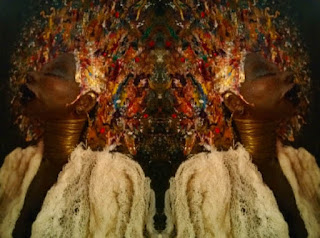
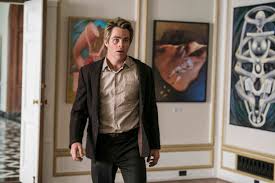
The art world in I Am the Night is a sinister and scary place. I began watching the TNT miniseries not knowing that the journey of the main character, a teenage girl named Fauna Hodel, would take her into a world of menacing-looking surrealist art and happenings populated with creepy characters, among both the performers and the audience.


The truth of Fauna's story is stranger than fiction. A teenage adoptee's quest for her identity leads her to uncover horrible secrets about the family that gave her away. Her grandfather, George Hodel, is a shadowy figure who is also a fixture in the art world.


His private collection of macabre paintings is on loan to a Los Angeles art museum. In the context of the film, the dismembered female figures are more like crime scene photos than art.


I am reminded of the part of Nanette where Hannah Gadsby talked about art history and women, and of a conversation I had with my late aunt while looking at abstract art with her at the Art Institute. What happens when women are reduced to mere parts by male artists? And what kind of men make art like that? And what do they really think of women? Have these artists made this work as a way to sublimate their true desire to act violently against women? Does this art primarily appeal to collectors who are themselves violent men? Have they confused sadism with a true creative vision?


At one point, it's hard to tell if her step-grandmother's contempt for her is out of racism or art world snobbery.


But despite her condescension, she teaches Fauna a few things about the contemporary art of their time that she is able to use to devastating effect in a dramatic confrontation with George Hodel. This California noir is like a V.C. Andrews novel in many aspects, and also has the Gothic element of a gloomy mansion.


 After listening to the podcast series, Root of Evil, that Fauna Hodel's daughters released in conjunction with the series, I learned that some of the situations and characters were added to give the story what my screenwriter cousin Darrell calls "Hollywood sizzle." But an interesting fact that was not included is that Fauna Hodel grew up to work in an art gallery.

For further reading, here's an article about the set design from Architectual Digest and an article about the artwork created for the show from Vulture.